Exhibitions
"Drifting Through Waters"
Duo show
Kristina
Õllek,
Anne-Laure
Wuillai
Curators: Kati Kull,
Merilin Talumaa
nomaadgalerie in collaboration with Roots to Routes
47, rue Chapon 75003 Paris
Exhibition from
November 14 to December 6, 2026
Tue-Sat 11 am - 7 pm
Contact:
With the support of:
Estonian Embassy in Paris &
Cultural Endowment of Estonia

With the collaboration of:


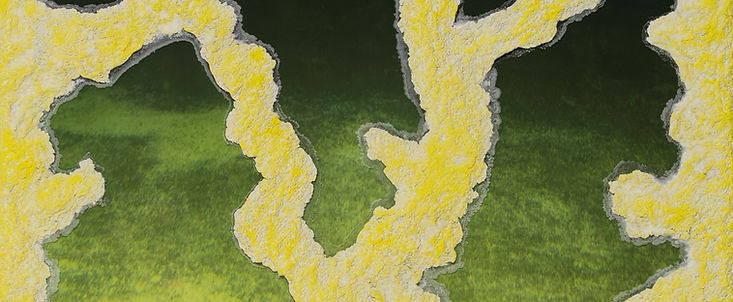
To drift is to surrender to a movement whose direction cannot always be known. It suggests a state of suspension, of being carried by currents that may lead somewhere unexpected, or nowhere at all. Beneath the seemingly endless surface of the sea, invisible processes unfold: organisms flourish and disappear, sediments accumulate, and traces of human activity travel through water, often far beyond their point of origin. There is both beauty and unease in this constant movement, a sense of life unfolding alongside the possibility of its disappearance. Bringing together Estonian artist Kristina Õllek and French artist Anne-Laure Wuillai, Drifting Through Waters explores this fragile and shifting territory between what we can observe and what remains hidden, between the sea as a source of life and as a witness to profound environmental change.
The exhibition unfolds between two bodies of water, the Baltic Sea and the Mediterranean, and two ways of approaching their changing realities. At its heart is a meeting between artistic imagination and scientific research, initiated through new collaborations established in 2026. Kristina Õllek entered into dialogue with Dr. Johannes Karstensen at GEOMAR Helmholtz Centre for Ocean Research Kiel, while Anne-Laure Wuillai began working with Dr. Andrea M. Doglioli at the Mediterranean Institute of Oceanography, Aix-Marseille University. Through these exchanges, observations gathered in the field, scientific knowledge, and artistic experimentation begin to flow into one another. The resulting works bring fragments of these conversations into the exhibition space, opening other ways of sensing and understanding marine environments. These encounters are not intended to end with the exhibition but to continue as long-term relationships between the artists and researchers.
For Kristina Õllek, the sea is a living environment in which geological histories, microscopic organisms, and human interventions are inseparably intertwined. Her long-term engagement with the Baltic Sea has led her to investigate oxygen-depleted waters, cyanobacterial blooms, and the fragile conditions of marine life. Moving between photography, installation, and microbial and chemical processes, Õllek allows the materials themselves to participate in the making of an image. In works such as Aerial view. Sedimenting Sediments (2024) and Cyanobacterial Bloom Index (2024), photographic surfaces are transformed through the growth of sea salt crystals, combined with cyanobacteria and fluorescent pigments. These materials evoke the processes of accumulation and transformation taking place within the Baltic Sea, where nutrient pollution and rising temperatures contribute to the proliferation of cyanobacteria and the formation of oxygen-depleted zones. While Õllek allows marine materials to transform the image itself, the resulting works become more than representations of the underwater world: they carry within them traces of the very processes they seek to reveal. These investigations continue through three new works created in dialogue with researchers at GEOMAR in Kiel, extending Õllek's exploration of the changing conditions of aquatic ecosystems. Her works possess a strange, almost otherworldly beauty, suggesting landscapes that seem to belong simultaneously to a distant past and an uncertain future, where signs of ecological disturbance appear both unsettling and unexpectedly seductive.
In the work of Anne-Laure Wuillai, the sea becomes something to collect, contain, preserve, and perhaps ultimately lose. Through sculptures, installations, and drawings, she explores the human desire to bring the vastness of water within reach, to transform it into an object of knowledge, memory, or possession. In Bibliothèque d’eau de mer (2021), seawater enters the ordered world of a library, suggesting an archive of something that is, by its very nature, impossible to fully preserve. Her Cartes postales (2025), Encriers (2026), and Porte-conteneurs drawings (2025) further evoke the ways in which the sea circulates through images, objects, and systems of exchange. These reflections take on a new dimension in a glass work created following her research visit to the Mediterranean Institute of Oceanography in Marseille. Inspired by a seawater sample from a scientific expedition, preserved in an ordinary Coca-Cola bottle, the piece reveals the curious contrast between the complexity of oceanographic research and the simplicity of containing a fragment of the sea. There is a quiet irony in these gestures of classification and containment: the more we attempt to capture the sea, the more its immensity and instability become apparent. Wuillai's work moves between tenderness and critique, revealing the contradictions of a relationship shaped by fascination, consumption, and the persistent wish to hold on to what is constantly changing.
Although the Baltic Sea and the Mediterranean are separated by geography, their waters carry interconnected histories of life, movement, and human intervention. The two artists approach these environments from different perspectives, yet their works meet in an attention to what the sea holds beneath its surface, and to the limits of our ability to comprehend it. Water becomes both a material and a metaphor: a carrier of memory, a space of transformation, and an uncertain territory in which the consequences of human activity continue to unfold. Drifting Through Waters invites us to linger within this uncertainty, between fascination and apprehension, where the beauty of marine life is inseparable from its vulnerability. To drift through these waters is perhaps also to confront our own position within them: not as distant observers of a world beneath the surface, but as participants in its changing currents, caught within the ecological transformations we are witnessing.
- Merilin Talumaa, curator, October 2026
"Honey en Route"
Solo show
Rebeka Vaino
Curator: Eliza Ramza
nomaadgalerie
9, rue Commines 75003 Paris
Exhibition from
October 22 to November 2, 2025
Tue-Sat 11 am - 7 pm
Sun 12 pm - 6 pm
Contact:
With the support of:
Ene Grauberg Foundation &
Estonian Embassy in Paris

nomaadgalerie presents "Honey en Route", the first solo exhibition in Paris by Estonian artist Rebeka Vaino
As untangling yarn, the twisted world is knitted into the forms. Each must shape it, forging a grid out of otherwise chaotic reality, weaving natural with artificial into resilient coat of protection.
Crochet, knitting and protective amulets resonate deeply as folkloric codes in Baltic culture, once serving as talismans of warmth and endurance for generations who survived wars, occupations, and scarcity. How to keep up the lightness, when ethos of today’s media lay heavy on us? What we let through our cocoon layer of self? In Rebeka’s practice, these ancestral gestures are transfigured into soft yet rigid sculptural forms, rendering time tactile, each element serving as preservation of memories – comforting yet elusive, light but vigorous.
Being tangled in a constant grid of connection, moving from city to city for work and leisure - motion itself becomes a condition of being. As much as linked as divided, searching for a state of belonging in the vast web.
Somewhere in between Nicolas Bourriaud’s prediction of “portable cultures” and Marcel Duchamp’s portable museum La boîte en valise, Rebeka invites the visitor to depart "Honey en Route" with a portable emotional k[n]it—a protective charm for contemporary existence.
Last summer, Rebeka completed her Master’s degree at Goldsmiths, University of London, presenting A Portable Paradise: What would you pack in your case of emergency kit? alongside performance The World Is Spinning Too Fast, I Need Something To Hold On To. "Honey en Route" continues this trajectory of embodied research practice: installations exploring materiality, ritual gesture, and Estonian pagan cosmologies, offering provisional sanctuaries within the turbulence of the present.
- Eliza Ramza, curator, September 2025
Press

Rebeka Vaino, Honey En Route, exhibition view, October 2025
Curator Eliza Ramza
Photo: Juan Couder

Rebeka Vaino, Honey En Route, exhibition view, October 2025
Curator Eliza Ramza
Photo: Juan Couder

Rebeka Vaino, Honey En Route, exhibition view, October 2025
Curator Eliza Ramza
Photo: Juan Couder
"I left my coat at Yours
Now I’m covered in the weight of distance.
Following the thread like many before,
Scale pointer sinks into infinity with all my memories dissolving in time
We are flaneurs in the heights of repeating history,
Keeping records of broken weaves,
Tiny grain in my shoe, mapping the roads of my soul.
Taste of plastic on Your lips,
When was the last time you lost track of time?
I will cover You one more time,
Rays of changes glowing on my wing.
Wrapping in the wind, I’m carried to the next stop.
Immersed in webs of invisible, emerge from Your tangled self
As you depart, don’t forget your protective charm
Multiple Le Galop crescendo"
- Eliza Ramza, curator, October 2025

Rebeka Vaino
Salty Light(ness), 2025
Handmade knit, resin
112 x 49 x 49 cm
44 1/8 x 19 1/4 x 19 1/4 in.
Photos: Juan Couder, Rebeka Vaino

Rebeka Vaino
Sails in the Night, 2025
Handmade knit, crochet, resin, beeswax, safety pins
125 x 50 x 40 cm
49 1/4 x 19 3/4 x 15 3/4 in.
Photos: Rebeka Vaino, Juan Couder
ERR "Päevakaja", n°23553 of October 21, 2025
Interview by Anett Peel with the artist Rebeka Vaino
https://arhiiv.err.ee/audio/vaata/paevakaja-nr-23550
Arterritory, "Soft Fabric Frozen in Shape", October 22, 2025
Interview by Eliza Ramza with the artist Rebeka Vaino
https://arterritory.com/en/visual_arts/interviews/27721-soft_fabric_frozen_in_shape/
Echo Gone Wrong, October 24, 2025
Photo reportage from the exhibition "Honey en Route" by Rebeka Vaino
https://echogonewrong.com/photo-reportage-from-the-exhibition-honey-en-route-by-rebeka-vaino-at-the-nomaadgalerie-in-paris/
"Next Stop – America?"
Solo show
Marko Mäetamm
Curator: Kati Kull
Estonian Embassy in Paris
17, rue de la Baume 75008 Paris
Exhibition from
May 22, 2025 to March 31, 2026
Mon-Fri on appointment
Contact Ms. Eike Eller:
Collaboration between:
Estonian Embassy in Paris &
nomaadgalerie


Marko Mäetamm
Next Stop - America?, 2025
Diptych
Acrylic on canvas
120 × 150 cm each
Price on demand
The title of the exhibition is taken, albeit in a slightly modified form, from one of my 1992 gouache paintings “NEXT STOP – AMERICA”. The work depicts a scene from a station lounge. Since the title refers to America, it should probably be in an airport. However, the interior of the lounge, with its ticket counters, is more reminiscent of a small-town bus station or a provincial train station. The arched doorway behind the rubber tree is particularly homely. In itself, of course, a perfectly logical interior, given the world in which I had lived and travelled all my life. No glass, no concrete. No New York panoramas shining through the floor-to-ceiling glass walls of the lounge. The world I had just come from, which had just ended with a bang, was more like a world that smelled a bit of socks and was a bit 'comrade-like'. Glamour had no place there.
But, yes, as already said, the world I had come from had ended with a bang. And the 90s had begun! And I was living the hectic life of a student of graphic arts at a school that is now called the Estonian Academy of Arts but has changed its name so many times that I can't remember what it was called at the time. When I entered, it was still the Estonian National Art Institute, or ERKI. My life as a student consisted of spending days and nights at school, and in my free time I printed my work on a lithography press. And when I wasn't doing that, I was making sketches for lithographs. Not all drafts turned into lithographs because some of them became too large to print, and the waiting room piece is one of them.
The 90s have been studied quite a lot by now, and you can certainly find all kinds of discussions and analyses of the decade on the internet with the help of AI. For me, the 90s were just a reality I had to adapt to, and I adapted without thinking about it. I coped with the ration stamp economy and savage poverty, I coped with the fact that the auntie sitting behind the counter in the public restrooms would give you a small roll of toilet paper rolled with her own hands from a large roll of toilet paper to make your number two, which at least for me was usually never enough. (And you could also buy cigarettes from the same auntie!) I had to cope with the fact that a careless shopper could get wood spirit* instead of Royal Spirit, because the labels on the bottles were almost identical. I had to cope with the fact that every night there was a loud bang above Tallinn and a booth, a garbage can, a pizza restaurant or a café was blown up. Sometimes with people inside, sometimes without. My ears didn't even notice the gun shooting. Poverty, crime, anarchy and a wild euphoric optimism despite all this! Interesting cocktail!
At that time, the Academy of Arts was a great place to study, because no one was interested in the old ideas about art. There were no longer any ideological trends. The lecturers didn’t really bother us, and you could do anything. It was all big testing and experimentation. At the same time, I personally knew very little about what was going on in art abroad. And I didn't really care, because I had so many ideas that I didn't have time to put them all to practice. Ideas came out of the whole weird atmosphere that prevailed. And my sort of poster-like, pop-arty handwriting, which developed pretty quickly, fitted in well with my great interest in the 60s and 70s music at the time, and was also a great fit with lithography techniques. Flat colour surfaces, pure tones, etc.
So I set to work, resonating with everything that was happening outside the window. Neon signs! English instead of Russian! Colourful things! Different clothes! The first tram running around the city, covered from head to toe with advertisements (Coca-Cola!)! Foreign car brands and so on! It was all so fierce and different, and I had no irony whatsoever in taking it all as fuel for my creation. Welcome to capitalism! Welcome consumer society and commerce! Welcome to advertising! I was, of course, only a mere observer in all this soup, and there was no question of any kind of consumption in my case, because money moved in other spheres. There where the pizza stalls that went flying and there where was haggling, scrambling, privatisation, appropriation, stacking, and where mega mansions with towers were being built. That's where the money moved. In my hands, it was a lithographic press that moved to record it all. And it was fierce!
There was only one thing to go to from there - America!
*-Methanol
- Marko Mäetamm, May 2025
"Implosion of the Universe"
Solo show
Robin Nõgisto
Estonian Embassy in Paris
17, rue de la Baume 75008 Paris
Exhibition from
July 20 to September 30, 2024
Mon-Fri on appointment
Contact Ms. Eike Eller:
Collaboration between:
Estonian Embassy in Paris &
nomaadgalerie


Robin Nõgisto
Dinosaur's Rebirth from Oil & Catnip Farmer Attack, 2021
Diptych
Acrylic on canvas
280 × 190 cm each
Price on demand
“Born in 1992, Robin Nõgisto, after obtaining a bachelor’s degree (BA) from the painting department of the Estonian Academy of Arts in 2017, has presented his creations on the Estonian art scene in several group exhibitions. His personal exhibitions have been held in Hobusepea gallery in 2016, in Art&Tonic gallery in 2019 and 2024 as well as at Tallinn Art Hall in 2021. Abroad, Robin Nõgisto’s has participated at the Miami Scope Art Basel art week, where his colorful and detailed paintings attained a lot of attention.
Nõgisto is one of the creators with the most outstanding handwriting among the new generation of Estonian artists. The bold rush of his colors rarely leaves the viewer cold. He has said that many things in his art have come from dreams. Sure, his works take the form of a psychedelic fantasy world drawing inspiration from the endless reservoir of popular culture, where Count Dracula could easily find himself jamming with the Beatles aboard a yellow submarine, and he wouldn't even be surprised by that fact.
The artist's paintings are characterized by large dimensions, voluminous compositions, clear contours, and bright colors in the style of pop art, and complex patterned surfaces reminiscent of op art. Not to mention comic-like, often humorous and/or horror-inducing details, such as the giant painting "The Bio Feel" exhibited at the annual exhibition of the Estonian Artists' Union at the Tallinn Art Hall in 2018.
"Robin's works do not choose their company, they extend a child's dreams and give sight back to the half-blind at the old age, they prefer a person from the street and a rock fan to a lover of high art and a music aficionado with a refined taste," has said curator Tamara Luuk.
In his work, the artist immerses himself in imaginary worlds filled with various inhabitants. Cats, dogs and lizards, hipsters, skeletons, and aliens wander from one canvas to another. Their possible belonging to the planet Earth is confirmed by the presence of houses, hearts, rainbows and lovely gifts of nature that appear here and there.
This rebellion of worlds is not easy to describe. The depicted activity involves the spectator in a noisy, stormy dance of life, the artist seems to laugh out loud, amused by the seriousness of daily efforts and constantly affirms that nothing is impossible.
"When I paint, words and explanations make everything more confusing. Perception, feelings, and words are different worlds," comments the artist. "I try to do something different with every work at hand. […] Ignorance is a fertile ground, and sometimes I surprise myself the most. [...] Painting offers me support even when things are out of hand, I see a lot of hope there."
"Portable Mystic Windows"
Solo show
Robin Nõgisto
nomaadgalerie
42, quai des Célestins, 75004 Paris
Exhibition from
July 30 to August 21, 2024
Tue-Sat 11am–7pm
Sun 12pm–6pm
Collaboration between:
Estonian Embassy in Paris &
nomaadgalerie

Robin Nõgisto
Cow Patrol from Space, 2023
Acrylic on canvas
170 × 200 cm
Price on demand
“We could say it looks like a bad trip to Wonderland. Notice that suspicious-looking cat with its bishop’s tiara, and a rainbow-colored vest, blessing by a vague gesture an unknown assembly of worshippers (Catholic Cat And The Holy Church Of Milk, 2024). Elsewhere, a haggard monster feeding on screens (Screen Vampire, 2024), merry aliens (Like Life, 2022), or yet this tribe of monkeys on the lookout for discounts on the parking lot of a “Super Mega Hyper Market” (Monkey Business, 2024). Everywhere, the same fluorescent colors, under electric skies. There is, it’s true, in all those scenes, something of a rejoicing hallucination. But let’s not be mistaken, under joyous exteriors, the world of Robin Nõgisto is rather cruel than kawaii.
Born in 1992, the young multifaceted artist got his education from the Estonian Academy of Arts. Painter, sculptor, muralist, he is also musician, singer, and videographer. From canvas to city walls, from the toys he assembles to rock tunes he composes, the same energy transits all his work, saturated, dense, uneasy sometimes, cynical, and irreverent. One must get rid of the first impression and the apparent friendliness and happiness of his compositions. All this, it’s sugar to the eyes, spread out in a showcase only to coax us. Like a too sour candy, it’s in the aftermath, once we have been plunged into the multitude of details overflowing each work, that their critical dimension unveils itself.
If a genealogy should be traced, we could go back to the fanzines and comics of the 1970s, firstly Robert Crumb, with his offbeat, excessive universe, his fondness of provocation and satire. Furthermore, how not to think of music videos of the next decade and of that unsettling dreaminess that made the success of the mythical film of Pink Floyd, The Wall (directed by Alan Parker in 1982). We should also mention the New York art scene of the same years, which saw the emergence of Keith Haring and Kenny Scharf introducing graffiti into the sphere of contemporary art. Finally, closer to us, it would be tempting to evoke a connection to the champions of Figuration Libre and the oeuvre of the French artist Hervé di Rosa, an ardent advocate of the “modest” arts (“arts modestes” in French). The common ground between all those different movements and Nõgisto’s painting? Above all, the freedom, the one to include all forms of creation, all inspirations; to invoke indifferently Fine Arts and the most popular productions, without a border of genre or origin, without hierarchy of values; a manner, also, to advance in reverse of a dominant taste.
To hold onto only this lineage would be to forget that the artist was born in a country occupied by the Soviet Union until 1991. Considering this, we could be tempted, of course, to add to the list of his inspirations the productions of the Soviet era, and in particular certain cartoons such as the “Box with a Secret” (Shkatulka s sekretom or Шкатулка с секретом) by Valery Ugarov (1976), a surrealist and disturbing tale in which a young boy dreams that he penetrates a snuffbox where an imaginary world opens up to him. Also, “Contact” (Kontakt or Контакт) by Vladimir Tarasov (1978), which portrays in the same psychedelic manner an encounter with aliens. However, and despite the aesthetical kinship, it would be to go the wrong way. Because Nõgisto is of a later generation, the one of a free Estonia, who watched as much “The Little Number Two” (Pikku Kakkonen, Finnish production), “Stepladder and Spaghetti” (Štaflík a Špagetka, Czechoslovak cartoon) as Scooby Doo or Tom & Jerry. Therefore, his childhood was less impregnated with the imagery of moral propaganda and more open to Western culture, also to liberalism and the promise of emancipation by the consumption of new goods.
Ambivalent, heterogeneous, Robin Nõgisto’s painting oscillates thus between a hallucinating Cadavre exquis and social satire. It is a celebration of a certain lust for life, of a desire to disobey and a criticism of ultraconsumerism; a denunciation of the society of screens and of misguided ways of religion, of violence and of dumbing down of the masses. Let’s say it is a world on its own, filled with dreams and nightmares, an insomniac painting that never lets us off the hook."
- Thibault Bissirier, art critic, 2024